
Botetourt County Deed Records and What They Show
Every Botetourt County land instrument is recorded by the Circuit Court Clerk. A deed names the parties. It also carries the legal description. That reference lets you follow the chain of title. Beyond deeds, the Clerk holds deeds of trust, releases, judgments, and wills that can all affect title.
| Deed Type | What It Does | Common Use |
|---|---|---|
| Conveyance deed | Records the grantor, grantee, land description, and transfer | Confirm a sale or other change in title |
| Deed of trust | Records a security instrument tied to land | Check a loan-related encumbrance |
| Release or satisfaction | Records an instrument that clears or changes a prior claim | Follow the deed of trust or lien trail |
| Judgment or lis pendens | Places a court-related record in the land trail | Review alongside the local court case file |
| Will or fiduciary transfer | May explain an estate path; the will alone may not update the roll | Check recorded deeds and probate records together |
A deed and a deed of trust do different jobs. The deed conveys the land. The deed of trust secures the loan behind it. Near the same parcel you may also find releases, easements, corrective instruments, and court filings, so ask the Clerk about the current index and image coverage before relying on any category list.
Using Botetourt's Grantor-Grantee Index
Virginia COVERS/SRA is the remote entry to the Botetourt County land-record index. Pick the locality first. Then match the party and role. A grantor conveys an interest; a grantee takes it. Write down every reference the index shows: book and page or instrument number, record date, party names, and the description. Field names, coverage start, sorting, and any result cap vary by clerk, so confirm those details with the Botetourt office before a deep parcel search.
- Find the most recent conveyance and note the current grantee, grantor, recording date, legal description, and deed reference.
- Search the grantor as an earlier grantee, using spelling, initials, married names, and entity-name variants.
- Read the earlier instrument instead of relying on the index line alone; compare land description and acreage.
- Move to deed books and microfilm when the remote index no longer reaches the transaction.
- Grantor
- The party conveying land or an interest.
- Grantee
- The party receiving the conveyance.
- Chain of title
- The linked sequence of recorded transfers for a parcel.
- Book/page or instrument number
- A clerk reference used to locate the recorded item.
Obtaining a Botetourt County Deed Copy
An index hit is not an image. Virginia's SRA terms vary by clerk. Some clerks offer free index-only access while images require local authorization, an agreement, and a paid subscription. Botetourt's copy charges and image start year are not published statewide, so call the Clerk before paying for a search or ordering a certified deed copy.
Recorded, not guaranteed. The Botetourt County index shows instruments that were recorded; an index entry is not a title opinion and may not reveal unrecorded interests. A title professional reviews the full chain and relevant documents.
COVERS Index and Image Access
The Virginia court system describes SRA as a route into circuit-court land records. Access differs by clerk. Some localities open the index without a subscription. Images depend on each clerk's setup. For Botetourt, COVERS/SRA exists. The coverage start, image availability, instrument dropdown, result limit, and per-page copy price are not published.
Never assume another county's rules apply. Start at the official locality selector. Note whether a result is an index record or the instrument image. If the index is all you get, copy the reference. Then ask the Clerk about image access, copies, or a certified deed. Confirm any temporary office location before visiting in person.
Virginia COVERS/SRA is the remote land-record entry point. 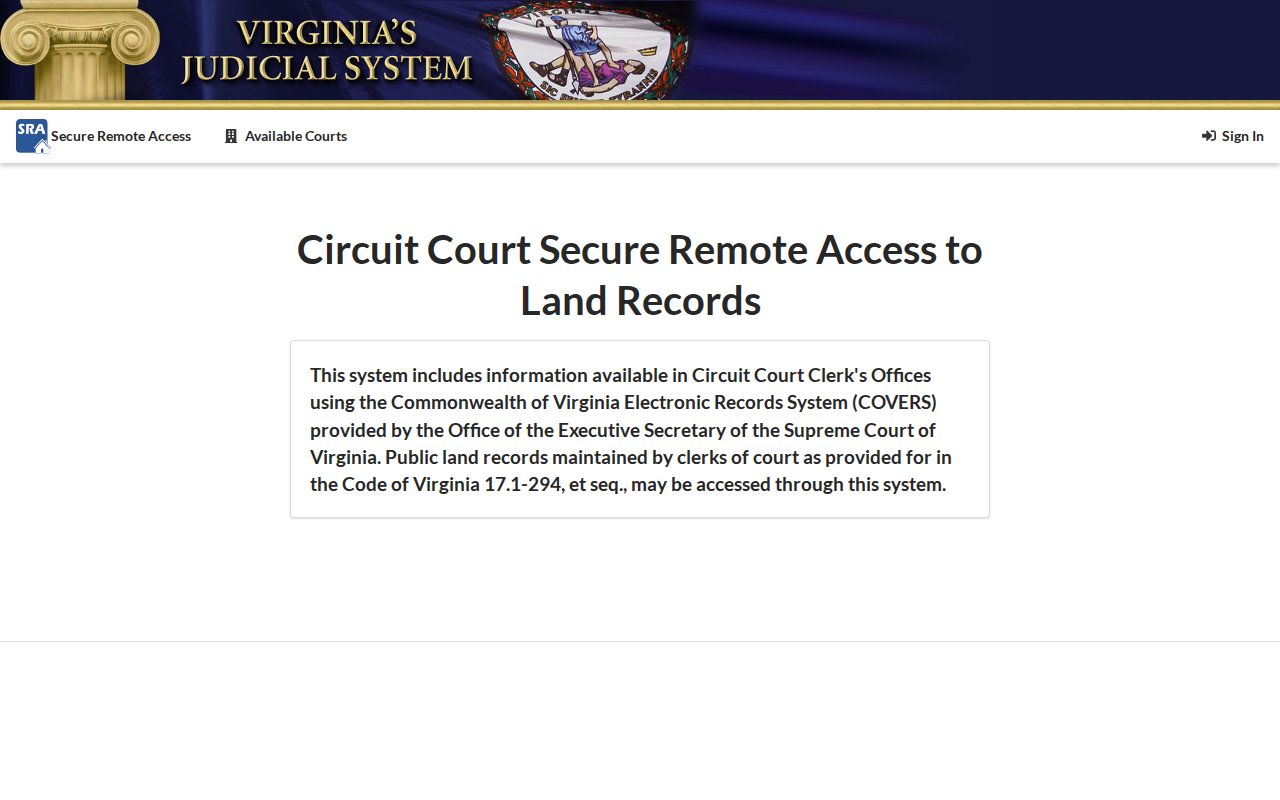 The landing screen does not itself show the document image or prove the index's earliest year.
Botetourt's Deed Books Begin in 1770
Botetourt's deed books reach back to 1770. The Library of Virginia's finding aid lists Deed Book 1 covering 1770 to 1773. Books 1 through 35 span 1770 to 1869. Books 36 through 58 carry the record to 1901. General indexes cover 1770 to 1889. Separate grantor and grantee reels cover 1890 to 1971 by letter groups, and 1972 volumes are listed apart. That inventory helps when the modern index stops.
Old deeds rarely name a modern address. Expect a farm, an acreage, a stream, a ridge, a road, or an adjoining owner. Find a predecessor in a modern deed first. Then work backward through the earlier grantee index, book by book, matching each legal description. Botetourt County formed from Augusta in 1770 and gained part of Rockbridge in 1785, so boundary shifts can change where a very old parcel was recorded.
The Library of Virginia finding aid lists Botetourt's book and index ranges. 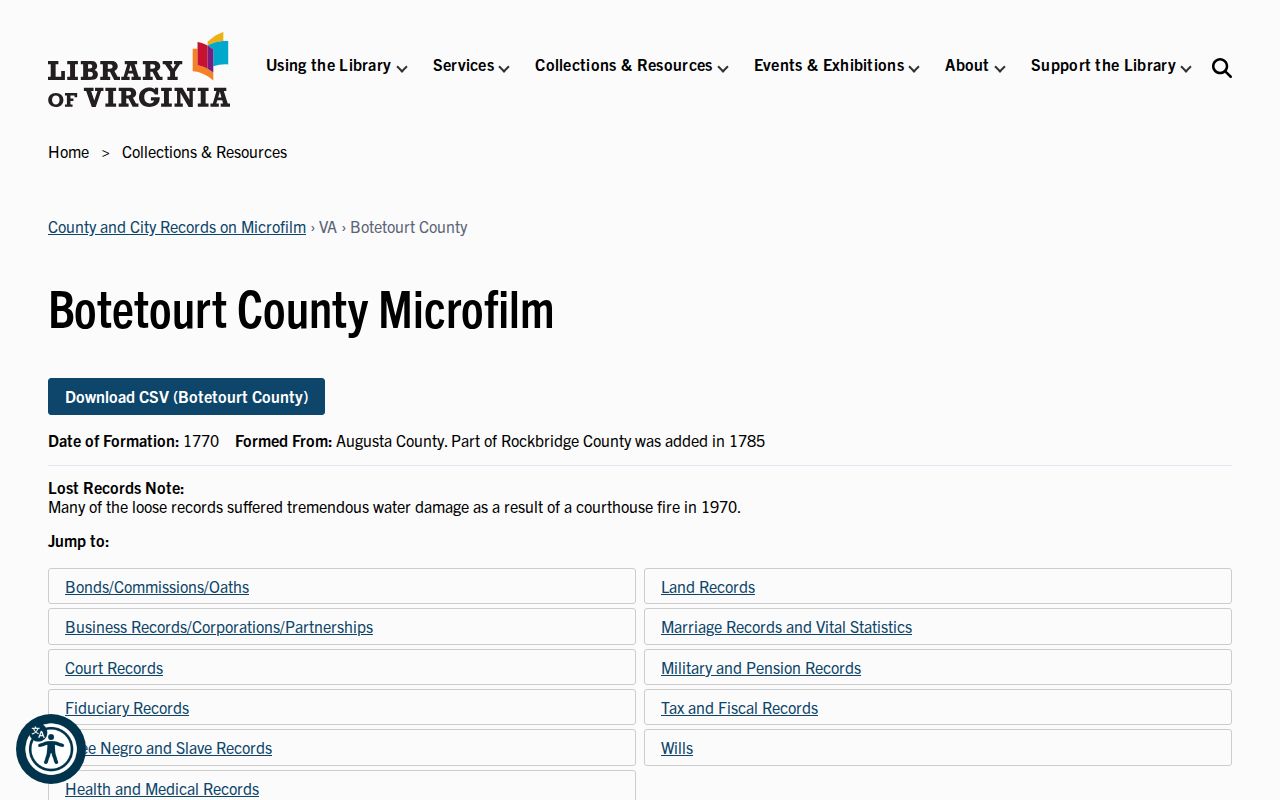 Use the reel description to request the right series.
How the 1970 Fire Affects Deed Research
The 1970 courthouse fire soaked many loose Botetourt County records. Water did most of the damage. Not every missing loose paper was a deed. Bound books, indexes, and microfilm often preserve the trail. When an image is missing, ask the Clerk what survives in the volume or reel. Then compare the Library of Virginia finding aid against local holdings.
The Fincastle Genealogy Room adds old surnames and street images. Botetourt Memory helps too. Such clues can point you to a name in the grantor-grantee index. They prove nothing about ownership. Keep title evidence in the recorded instruments and treat archival material as context.
Probate Transfers in Botetourt
Death breaks the simple buyer-to-seller chain. A personal representative, executor, trustee, devisee, or heir may surface in an estate instrument instead. Search the decedent in both roles. Check grantor and grantee entries alike. Wills and fiduciary records sit with the Circuit Court Clerk, though a will may describe land without being the recorded deed that updates the assessment card.
The Library of Virginia holds deep Botetourt estate material. Guardians' accounts run 1799 to 1839. Fiduciary records cover 1870 to 1882 and 1922 to 1946, with audits, appraisements, and accounts of sale from 1881 into the early 1900s. Fincastle Library and Botetourt Memory add cemetery, family, and obituary leads, but the Clerk's recorded land instruments remain the title route.
Requesting a Botetourt Instrument
When an SRA image is unavailable, contact the Circuit Court Clerk, Tommy L. Moore, at P.O. Box 219, Fincastle, VA 24090, phone 540-473-8274, fax 540-473-8209. Include the parties, approximate date, deed type if known, and book/page or instrument number. Ask whether the requested copy can be mailed, viewed at the counter, or certified. The exact fee schedule was not found in the research, so confirm price before sending payment.
For existing public administrative files rather than a deed copy, Botetourt's FOIA page lists JustFOIA, mail, fax, email, phone, and in-person channels. FOIA does not replace court procedures or create an instrument that the Clerk does not hold. A narrow request with a record reference is easier to route.
If the index gives only one party name, include that spelling and the other party if known, plus an approximate transaction date and any map/RPC clue. A useful copy request identifies the kind of instrument sought and asks whether the copy includes attachments or exhibits referenced in the deed. If a formal title question depends on an exact chain, ask a title professional what period and document types need review; this guide cannot certify that an index search is complete.
The Clerk's official directory entry gives the current contact information.  Call to confirm the correct service before visiting.
Tax Sale Notices and Deed Transfers
A delinquent-tax notice can reveal an owner name. It can also show a tax-map number, RPC number, TACS number, and a parcel offered through a judicial process. Botetourt's August 2023 notice shows those fields side by side. It also spells out redemption in terms of accumulated taxes, penalties, interest, costs, and fees. Remember what the document is. The notice is part of a tax proceeding. It is not the deed that conveys the land to a later buyer.
To trace what happened next, ask the Treasurer about the account. Then ask the Circuit Court Clerk for a later recorded instrument. Keep the notice date separate from any deed recording date. Preserve the parcel keys either way. A delinquent balance can be resolved while ownership stays the same. A later conveyance can follow the notice. Treating one tax list as the whole title history leaves a key stretch of the chain unchecked.
If a judicial sale or other court proceeding appears in the history, the Virginia court case-information service can help identify the case reference. Virginia's official case-information portal is a court docket route, not the land-record index. 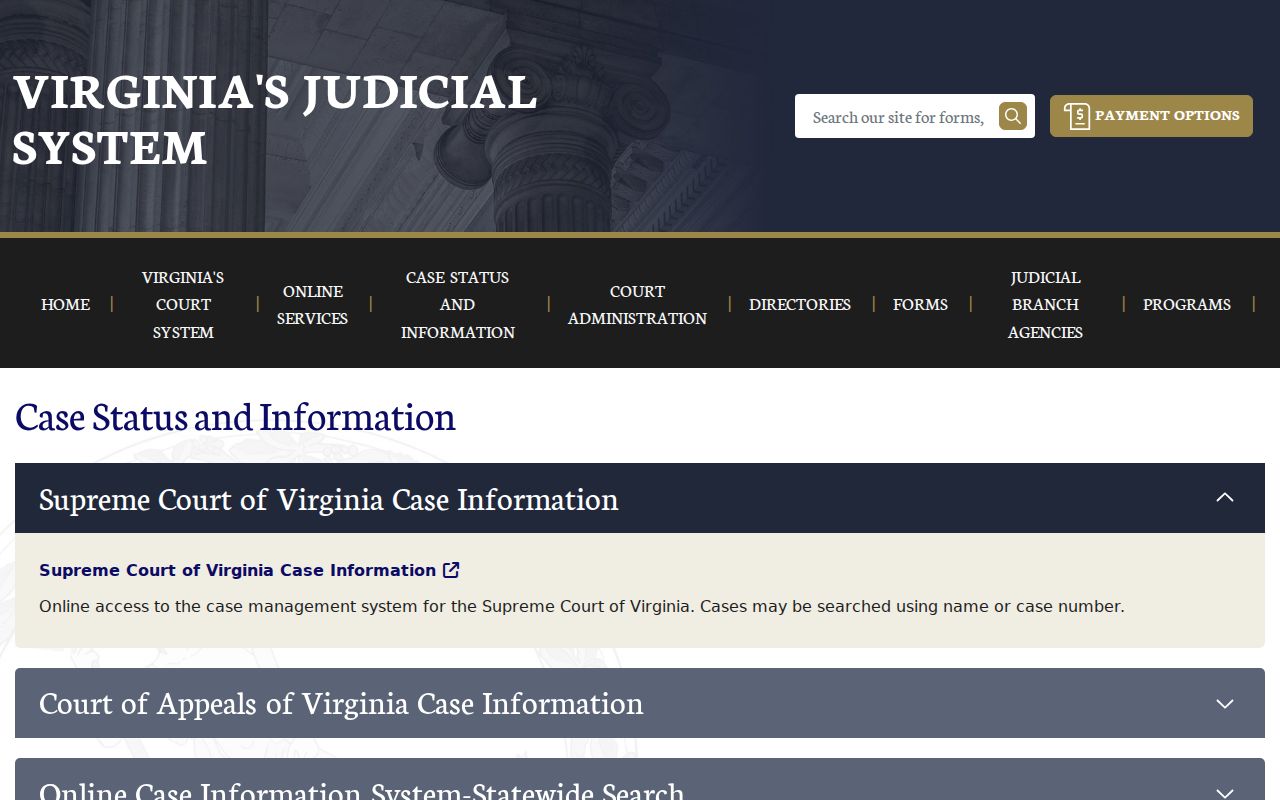 Use the Circuit Court Clerk's recorded deed to confirm any later transfer of the parcel.
Reading the Recorded Instrument
An index entry is only a locator. The recorded image or deed book holds the instrument's full description. Check that the parties appear as grantor and grantee. Note the instrument type and date. Read the land description for acreage, lots, exceptions, easements, or references to an earlier plat. A short index label can hide those terms. Compare the description with your starting parcel before adding the deed to a chain.
Where an estate is involved, note the capacity of each signer. A trustee, executor, administrator, or personal representative is not the same as an individual owner. If a scan is faint or a cited exhibit is missing, ask the Clerk. Request the full instrument and any separately recorded plat. Careful reading matters most where the courthouse fire affected loose records. A modern map key came long after the original description.